Before packing, check this list of items prohibited from entering a particular country or region.
Unfortunately, due to the ongoing conflict in the Middle East, shipping lines have temporarily suspended shipments to and from Oman until further notice.
Due to the global Microsoft Outlook outage, our Business Centre is currently unable to send or receive emails, including automated notifications. We apologise for any inconvenience caused.
Content review
Written by: John Henderson (Co-founder and Managing Director of Seven Seas Worldwide)
Last reviewed: November 2026
Key takeaways
- Canada has four main visa categories: visitor, work, study and permanent residence, each with different eligibility requirements.
- Temporary visas don’t guarantee permanent residence: working or studying in Canada may help you qualify, but you’ll need a separate immigration application.
- There are several routes to permanent residence: Express Entry, provincial nomination, family sponsorship, and regional immigration programmes.
- You don’t always need a job offer: some skilled immigration pathways allow eligible applicants to apply without securing Canadian employment first.
- Your work experience matters: qualifying occupations in healthcare, STEM, skilled trades and education may offer additional immigration opportunities.
What are the 4 types of visa in Canada?
The four main types of Canadian visas and immigration permissions are visitor visas, work visas, study visas, and permanent residence visas.
Each serves a different purpose, from short holidays and temporary employment to education and permanent settlement.
|
Visa type
|
Main purpose
|
Who it's for
|
Typical length of stay
|
|
Visitor visa
|
Tourism, family visits and permitted business activities
|
Tourists and short-term visitors
|
Usually up to 6 months per visit
|
|
Work visa
|
Employment in Canada
|
Foreign workers with eligible work permits
|
Depends on the work permit
|
|
Study visa
|
Education at a Canadian institution
|
International students
|
Generally linked to the study programme
|
|
Permanent residence visa
|
Long-term settlement
|
Eligible skilled workers and families
|
Permanent
|
![]()
Visitor visa
A Canadian visitor visa, also called a Temporary Resident Visa (TRV), allows eligible foreign nationals to visit Canada temporarily.
It's commonly used for holidays, visiting friends and relatives, attending conferences and permitted business activities.
Most visitors can stay for up to six months per entry, although border officials may authorise a different period.
There are also specialised visitor options:
- Super visa: allows eligible parents and grandparents of Canadian citizens, permanent residents and registered Indians to visit for up to five years at a time.
- Business visitor: for activities such as meetings and conferences without entering Canada's labour market.
- Transit visa: for eligible travellers passing through Canada en route to another country.
Depending on your nationality and how you travel, you may need an electronic travel authorisation (eTA) rather than a visitor visa. Eligible visa-exempt travellers generally need an eTA when flying to Canada, but not when arriving by land or sea. Check the requirements for your passport and travel route.
A visitor visa isn't normally suitable for someone intending to take up employment or live permanently in Canada.

![]()
Work visa
Canadian work visas allow eligible foreign nationals to work in Canada for a specified period.
Canada offers two principal work permit arrangements:
Employer-specific work permit
This allows you to work under conditions associated with a particular employer, occupation, or location.
You'll generally need a Canadian job offer, and your employer may need a Labour Market Impact Assessment (LMIA), depending on the employment programme.
Open work permit
An open work permit allows eligible applicants to work for most Canadian employers without being tied to one organisation. Eligibility is restricted to specific groups, including certain graduates and qualifying spouses or partners. For example, spouses of international students generally qualify only if the student is enrolled in a master's programme of at least 16 months, a doctoral programme or another specified eligible programme.
Other work-related options include International Experience Canada's Working Holiday programme, Young Professionals programme, and certain post-graduation work permits.
These arrangements are particularly relevant to those who want to experience Canadian working life before considering permanent settlement.
Before accepting a Canadian role, check the work permit conditions and whether the employment could count towards a future permanent residence application.
![]()
Study visa
A Canadian study permit allows international students to study at eligible Canadian educational institutions.
Most students planning to complete a longer academic programme need a study permit.
Applicants generally require an offer from a designated learning institution, sufficient financial resources and supporting immigration documentation.
Some graduates can apply for a Post-Graduation Work Permit (PGWP), which allows them to gain Canadian employment experience after finishing their studies.
However, not every institution or course qualifies for a PGWP. Eligibility depends on the programme, institution and other conditions, including language or field-of-study requirements where applicable.
![]()
Permanent residence visa
Permanent residence is the main immigration option for people planning a long-term move to Canada.
Permanent residents can generally live, work and study throughout Canada, subject to immigration conditions and ongoing residency obligations.
There are several routes to obtaining permanent residence, including:
- Express Entry for eligible skilled workers.
- Provincial Nominee Programs.
- Family sponsorship.
- Regional immigration programmes.
- Quebec's separate immigration selection programmes.
The most suitable route depends on your professional background, education, language proficiency, family circumstances, and intended destination in Canada.
Which Canada visa is best for moving permanently?
If you're moving to Canada permanently, start by investigating your eligibility for permanent residence.
Your strongest pathway will depend on whether you qualify through skilled employment, family connections or a province's immigration priorities.
Your job title alone won't determine your Express Entry eligibility. What matters is whether your actual duties match the correct Canadian NOC classification.
Express Entry: for skilled workers
Express Entry is Canada's online application management system for skilled immigration.
It manages three immigration programmes.
Federal Skilled Worker Program (FSWP)
The FSWP programme can be suitable for professionals who have gained skilled work experience outside Canada.
Applicants generally require at least one year of continuous qualifying paid employment within the previous ten years, along with suitable language results, education, and other eligibility criteria.
Work experience must fall within eligible National Occupational Classification (NOC) categories.
Candidates must also score at least 67 out of 100 points on the FSWP selection grid before entering the Express Entry pool.
Canadian Experience Class (CEC)
The CEC programme is aimed at people who already have eligible Canadian work experience.
Applicants generally require at least one year of qualifying skilled employment in Canada within the previous three years.
It can be relevant to foreign nationals who have previously worked in Canada under an appropriate work permit.
Federal Skilled Trades Program (FSTP)
Designed for eligible skilled tradespeople, the FSTP programme generally requires at least two years of qualifying trade experience within the previous five years.
Applicants must also meet other requirements, including having either a qualifying Canadian job offer or a Canadian certificate of qualification.
How does Express Entry select applicants?
Eligible candidates enter the Express Entry pool, where they're ranked using the Comprehensive Ranking System (CRS).
The CRS considers factors such as age, education, language proficiency, skilled work experience and other relevant qualifications.
Canada then invites selected candidates to apply for permanent residence. Meeting the minimum eligibility requirements doesn't guarantee an invitation.
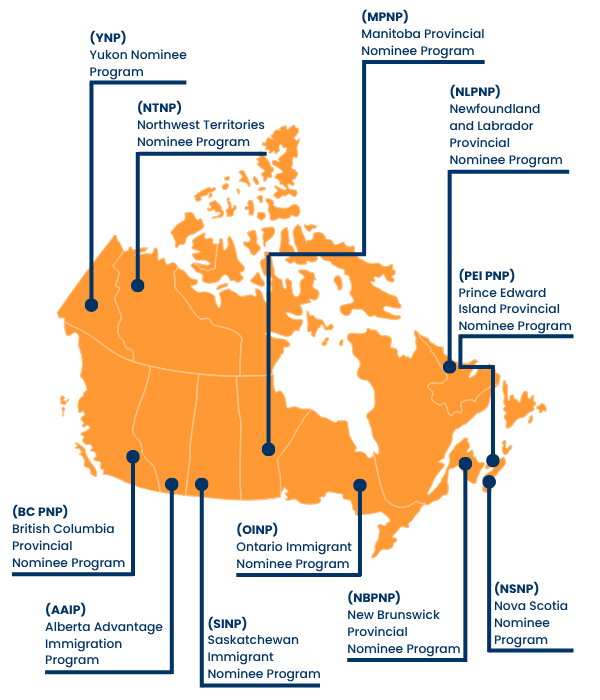
Provincial Nominee Program (PNP)
Canada's Provincial Nominee Program (PNP) allows participating provinces and territories to nominate applicants whose qualifications match their economic and employment needs.
For example, one province may prioritise healthcare professionals, while another may offer immigration streams for skilled tradespeople or workers with relevant local employment.
Applicants must meet the requirements of the particular provincial stream and generally demonstrate an intention to settle in that province.
An eligible Express Entry-linked provincial nomination adds 600 CRS points, significantly strengthening the applicant's ranking.
Quebec operates a separate skilled immigration selection system and doesn't participate in the PNP.
Family sponsorship
If you have close family members who are Canadian citizens or permanent residents, family sponsorship may be appropriate.
Eligible sponsors can apply to bring certain relatives to Canada as permanent residents, including spouses, qualifying partners and dependent children.
Some additional family sponsorship categories exist, including those for adopted children and orphaned family members; however, their availability and application conditions differ.
Applicants and sponsors must meet the requirements of the relevant programme.
Regional immigration programmes
Canada also offers immigration routes designed to attract skilled workers to particular regions.
Examples include the Atlantic Immigration Program and the Rural and Francophone Community Immigration Pilots.
These programmes can be worth investigating if you're willing to relocate to a participating community and meet its employment and immigration requirements.
They often require a qualifying job offer from a designated employer.
![]()
Provincial Nominee Programs across Canada
A map of Canada's provincial and territorial nominee programmes, showing participating regions and their programme abbreviations. Quebec and Nunavut do not participate in the PNP.
How to apply for a Canada visa
The application process depends on which Canadian visa or immigration programme you're pursuing.
A tourist applying for a visitor visa will follow a different procedure from someone seeking permanent residence through Express Entry.
However, most applications involve six main stages:
Choose the correct visa
Identify the purpose of your visit or relocation and the permission you'll need.
If you're travelling temporarily, check the visitor, work or study requirements.
If you're hoping to settle permanently, explore Express Entry, provincial nomination, family sponsorship or other relevant immigration programmes.
Canada's official immigration programme explorer can help you identify suitable options.
Check your eligibility
Canadian visa requirements depend on the specific immigration category. For example:
- Visitor visa applicants generally need to demonstrate that they meet temporary entry requirements and intend to leave Canada when their authorised stay ends.
- Work permit applicants may need an eligible Canadian job offer or to qualify for a particular open work permit category.
- Study permit applicants generally require acceptance from a designated learning institution and sufficient funds.
- Skilled permanent residence applicants may need qualifying employment experience, education assessments and approved language test results.
Check the official requirements before paying application fees or making major relocation commitments.
Gather your supporting documents
The document checklist depends on your visa type. Visitor visa applicants may need travel plans, proof of funds and evidence of ties outside Canada; work permit applicants may need a job offer and supporting employer documents.
Study permit applicants generally need an acceptance letter from an eligible institution, proof of funds and, unless exempt, a provincial or territorial attestation letter. Permanent residence applicants may need language test results, educational assessments, and employment records, alongside police certificates and medical examination results, where required.
For permanent residence, accurate documentation of your work history is especially important.
Employment reference letters should clearly explain your duties, employment dates, working hours, and remuneration.
Submit your application
Most Canadian visa and immigration applications can be submitted online through the appropriate Immigration, Refugees and Citizenship Canada (IRCC) system.
For Express Entry, you first create a profile and enter the candidate pool.
If you receive an invitation to apply for permanent residence, you normally have 60 days to submit your completed application and supporting documents.
Pay fees and complete any required checks
Application fees depend on the immigration category and the number of applicants included.
You may also be asked to provide biometric information, police certificates or medical examination results.
Follow the instructions for your specific application and respond promptly to requests for further documentation.
Receive a decision and prepare to travel
Processing times vary by visa type, application circumstances and the volume of applications being assessed.
Check IRCC's current processing times before planning your departure.
If you're approved, review the conditions of your visa, permit or permanent residence documentation.
For people planning a permanent move, this is also the stage to finalise accommodation, employment arrangements and international shipping.
Canada Skilled Occupation List
Your occupation and employment history can significantly influence your eligibility for Canadian skilled immigration programmes.
Canada uses the NOC system to categorise jobs.
Occupations are grouped according to their Training, Education, Experience and Responsibilities (TEER).

How to find your occupation's NOC code
Your NOC code helps determine whether your work experience qualifies for Canadian skilled immigration programmes. It can also affect your Express Entry ranking.
To find the correct code:
- Visit the official Canadian NOC lookup tool.
- Search for your current or previous job title using the NOC 2021 classification.
- Compare the occupation's main duties with the work you actually performed. Your responsibilities must match the classification, not simply your job title.
- Note the five-digit NOC code and its TEER category.
- Check whether your occupation qualifies for your chosen immigration programme and any relevant Express Entry selection categories.
Your NOC code is also important when calculating your Express Entry CRS score.
Under the Express Entry Labour Market Integration factor, applicants may receive points for qualifying Canadian work experience (including extra points for eligible high-wage occupations) or for a qualifying job offer in a high-wage occupation. IRCC uses whichever option yields the higher score; the two scores cannot be added. High-wage eligibility is based on national wage data for the NOC code, not the applicant's individual salary.
Check the official Express Entry high-wage occupation list to see whether your NOC code qualifies.
A matching NOC code is only a starting point: your qualifications, language results, immigration eligibility and overall CRS score still affect your prospects of receiving an invitation.
Understanding Canada's NOC and TEER system
| TEER category | General description |
|
TEER 0
|
Management occupations.
|
|
TEER 1
|
Occupations usually requiring a university degree.
|
|
TEER 2
|
Occupations generally requiring college education, substantial apprenticeship training or supervisory experience.
|
|
TEER 3
|
Occupations generally requiring a shorter diploma or apprenticeship training, or significant on-the-job training.
|
|
TEER 4
|
Occupations generally requiring secondary education or several weeks of training.
|
|
TEER 5
|
Occupations generally requiring brief work demonstrations or no formal education.
|
The FSWP and CEC generally require eligible experience in TEER categories 0–3.
However, being employed in one of these categories doesn't automatically qualify you for immigration.
Your work history must satisfy the requirements of the specific programme.
Which skilled occupations are in demand in Canada in 2026?
Canada's 2026 Express Entry category-based selection priorities include healthcare and social services, STEM, skilled trades, education and transport.
The system also includes categories for qualifying French-speaking applicants, certain professionals with Canadian work experience and eligible skilled military recruits.
Examples of occupations appearing in the 2026 category lists include:
| Occupation | NOC code | Priority sector |
|
Registered nurses
|
31301
|
Healthcare
|
|
Cybersecurity specialists
|
21220
|
STEM
|
|
Welders
|
72106
|
Skilled trades
|
|
Secondary school teachers
|
41220
|
Education
|
|
Aircraft mechanics and inspectors
|
72404
|
Transport |
These examples aren't a complete list of eligible occupations.
For the principal occupation-based Express Entry categories, applicants generally need at least 12 months of qualifying work experience in a listed occupation within the previous three years.
That experience can usually have been gained in Canada or abroad. Separate conditions apply to categories specifically requiring Canadian experience.
Applicants must also meet the requirements of an Express Entry immigration programme.
Visit IRCC's category-based selection guidance for the latest lists of eligible occupations.

What is the best job experience for getting a long-term Canada visa?
No particular profession guarantees Canadian permanent residence.
However, relevant skilled employment, strong language results and well-documented professional experience can make an application more competitive.
Work experience in an eligible skilled occupation
Experience that matches a qualifying NOC occupation is a useful foundation for economic immigration.
For example, someone with several years of experience as a civil engineer may meet the occupational requirements for the FSWP.
However, their education, language results and other immigration criteria will also be assessed.
Experience in a priority occupation
Work in a current Express Entry priority sector can provide additional selection opportunities.
For instance, eligible nurses, electricians, teachers and certain engineering professionals may qualify for occupation-based invitation rounds.
Selection priorities change, so a profession appearing on the current list isn't a guarantee of future eligibility.
Canadian employment experience
Qualifying Canadian work experience can be particularly valuable.
For example, a worker who completes at least one year of eligible skilled employment in Canada may satisfy the minimum work experience requirement for the CEC.
Their work must meet all relevant programme conditions.
Several years of relevant professional experience
Additional qualifying work experience may improve immigration selection points, depending on the programme.
For the FSWP, applicants with six or more years of qualifying experience can receive the maximum available points for the work experience selection factor.
However, longer experience doesn't automatically compensate for insufficient language results or other missing requirements.
Recognised qualifications and strong language skills
Canadian immigration programmes assess more than employment history.
Education, professional qualifications and approved English or French language results can influence eligibility and competitiveness.
Some professions, including nursing, teaching and engineering, are also regulated in Canada. You may need provincial licensing or recognition of your qualifications before you can practise.
Can you move to Canada without a job offer?
Yes. Some Canadian permanent residence programmes don't require applicants to have a job offer. For example, the FSWP and CEC generally allow eligible applicants to pursue permanent residence without a job offer. However, you'll still need to meet the programme's work experience, language and other eligibility requirements.
Other routes, including some provincial nomination streams and regional immigration programmes, may require employment arranged in advance. If you're considering relocating without a job offer, assess your eligibility and realistic employment prospects before incurring major moving expenses.
Keep your shipping inventory and customs documents handy to help avoid delays.
What to do after your Canada visa is approved
Once your immigration arrangements are in place, you can begin preparing for the practical aspects of relocating.
Alongside accommodation and employment, you'll need to consider banking, healthcare registration, travel documents and how to transport your belongings.
Check customs requirements before shipping
If you're moving to Canada with personal belongings, Canadian customs rules may apply to goods you're travelling with and to items arriving separately.
Eligible people establishing residence in Canada may qualify for duty and tax relief on certain household possessions, subject to the Canada Border Services Agency's (CBSA) conditions.
You'll need to prepare an accurate inventory and declare your goods when you arrive. Before packing, check which items are prohibited or restricted for shipment to Canada, as some everyday belongings may be subject to customs or transportation restrictions.
The CBSA uses Form BSF186, the Personal Effects Accounting Document, to record relevant personal effects. Additional inventories, including Form BSF186A, can identify belongings arriving later.
For example, if you're flying to Toronto while your furniture and household possessions are being shipped by sea, your goods-to-follow declaration should identify the items that will arrive separately.
This is important because goods not properly declared on arrival may not qualify for the same customs treatment.
Read the official CBSA moving or returning to Canada guidance.
Choose the right international shipping service
The amount you're relocating will influence which international shipping option makes sense.
Someone moving with clothing, books and a few personal possessions will have different requirements from a family shipping furniture and household goods.
For customers moving from the UK to Canada, Seven Seas Worldwide offers international removals to Canada, including two principal options.
Boxes and Bags Shipping
Designed for shipping smaller quantities of personal belongings, such as clothes, books and other suitable items.
It can be an alternative to travelling with excess luggage.
MoveCube® international removals
The MoveCube® is a dedicated moving container designed for transporting household possessions overseas.
Available in different sizes, it can accommodate suitable larger shipments, including furniture and packed boxes. Multiple MoveCubes® may be an option for bigger relocations.
The most appropriate service depends on your shipment, available routes and delivery requirements.
Research shipping arrangements early enough to understand packing requirements, customs responsibilities and the costs associated with transporting your belongings.
Check packing rules, shipping costs and delivery options before booking to avoid unexpected delays or expenses
Frequently asked questions about Canada visa types
There isn't one visa that's universally easier to obtain.
Eligibility depends on your circumstances, nationality and reason for travelling.
A visitor visa may involve fewer eligibility requirements than some permanent residence programmes, but it doesn't allow you to settle permanently.
The most useful approach is to choose the immigration option that genuinely matches your intentions and qualifications.
Potentially. Eligible Canadian work experience may help you qualify for the CEC, a provincial nomination stream or another immigration programme.
You'll still need to meet the applicable requirements and receive immigration approval.
Depending on your immigration status and programme, eligible family members may be able to accompany you or apply for related immigration permission.
The requirements differ for spouses, partners, dependent children and other relatives.
Processing times vary by application type, nationality and individual circumstances.
Visitor visas, work permits, study permits, and permanent residence applications can have substantially different processing periods.
Always consult IRCC's current estimates rather than assuming a particular approval date.
Match the visa to what you plan to do: a visitor visa or eTA for a short stay, a work permit for employment, a study permit for eligible courses or a permanent residence route if you want to settle.
For a permanent move, compare Express Entry, provincial nomination and family sponsorship against your qualifications, work experience and family circumstances.
Use IRCC's official guidance to check eligibility before committing to major travel or relocation costs.