Unfortunately, due to the ongoing conflict in the Middle East, shipping lines have temporarily suspended shipments to and from Oman until further notice.


Beyond the Boxes: celebrating 30 years of international removals
The Inventory Packing List joke that cost an Australian expat dearly

To celebrate 30 years of helping people move across the globe, we're opening the lid on life behind the scenes in international removals. Through our Beyond the Boxes series, we're sharing some of the memorable stories, hidden challenges and fascinating moments that have shaped three decades in the business.
Why your Inventory Packing List is no laughing matter
Over three decades in international removals, we've seen just about everything, and while some of our stories make us smile, others serve as valuable lessons, and a few do both. This is one of them.
Moving from Australia to the UK can be stressful. Between organising visas, saying goodbye to friends and packing up years of possessions, most people are focused on getting their belongings safely from A to B.
Not Michael (name changed to spare him further embarrassment!).
As he completed the Inventory Packing List for his shipment from Sydney to Manchester, the 38-year-old teacher decided to entertain himself with a practical joke.
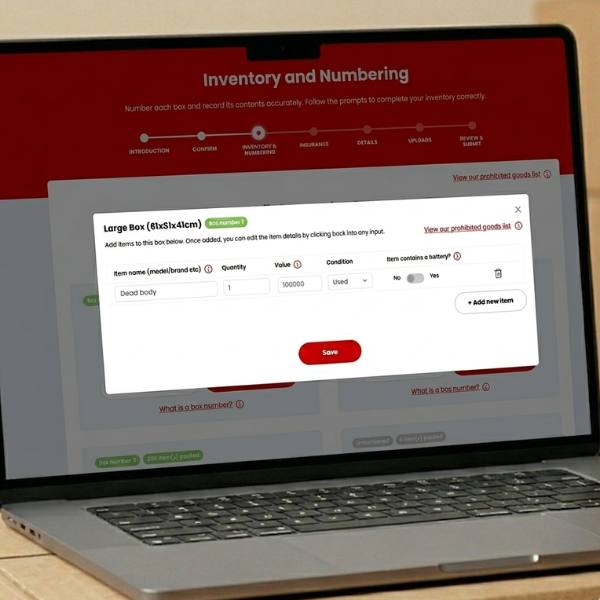
Under the contents of one box containing family photo albums, kitchen appliances and assorted household items, he typed:
“One dead body (don’t worry, it’s only my mother-in-law).”
Certain that nobody would take the comment seriously, he submitted his paperwork and forgot all about it.
Three months later, the joke came back to haunt him.
“I honestly thought someone would see the funny side”
By the time Michael’s shipment arrived in the UK, his belongings had travelled thousands of miles by sea and passed through multiple stages of documentation checks.
Like every Inventory Packing List, his paperwork accompanied the shipment throughout its journey and was reviewed by customs authorities. What Michael had assumed was an obvious joke was interpreted very differently.
After all, customs officers don’t deal in sarcasm.
Their job is to assess risk.
And when a declaration contains the words “dead body”, there is only one sensible response: investigate.
Michael received a call informing him that his container had been flagged for examination. The shipment was placed on hold while officials arranged a physical inspection.
“It wasn’t until someone from the clearance team called me that I realised what I’d done,” he later admitted.
“They asked whether there had been an error on my inventory. That’s when my stomach dropped.”
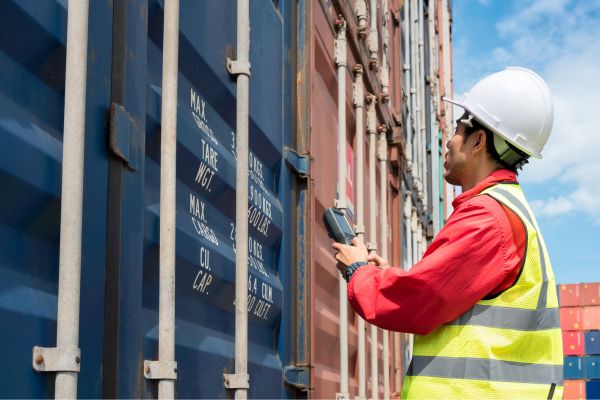
...ensure imported goods comply with regulations, protect public safety and prevent illegal or prohibited items from entering the country.
Why customs couldn’t simply ignore it
Most people would see the entry as ridiculous.
But to customs authorities, every declaration is a legal document.
Officers cannot make assumptions or decide that something “probably means nothing”. Their role is to ensure imported goods comply with regulations, protect public safety and prevent illegal or prohibited items from entering the country.
That’s why customs authorities around the world insist on accurate inventories. They use them to:
- Identify prohibited or restricted items.
- Assess whether duties and taxes apply.
- Carry out quarantine and biosecurity checks.
- Detect smuggling and fraudulent declarations.
- Protect public health and national security.
- Decide which shipments require physical examination.
If the information isn’t accurate, customs officials can’t do their job properly.
The consequences
Fortunately, the inspection quickly established that his shipment contained no deceased relatives, only the contents of a typical family home, including furniture that had survived several house moves, photo albums documenting years in Australia, boxes of treasured keepsakes and the kind of "I'll sort through it one day" belongings that somehow end up making every international move.
But by then, the damage was done.
Because the shipment had been selected for examination, Michael faced:
A delay of almost three weeks
The suspicious declaration prompted a detailed inspection, leading to the entire shipping container being held while customs officials completed their checks. As a result, not only were Michael's belongings delayed by nearly three weeks, but the hold-up also affected several other customers whose consignments were travelling in the same container.
Additional handling and inspection fees
Physical examinations involve labour, storage and administration costs. These charges are passed on to the shipment owner.
Storage charges
Because the container exceeded its free storage period, additional charges were incurred while customs procedures were completed.
Extra paperwork
Michael was required to provide written clarification and revised inventory documentation.
Plenty of embarrassment
Perhaps the most painful consequence was explaining to his wife why the contents of their family home, including heirlooms, favourite pieces of furniture and the countless possessions they'd spent weeks packing, were now stuck in a customs inspection facility.
“She found it significantly less funny than I did,” he admitted.
As a result, not only were Michael's belongings delayed by nearly three weeks, but the hold-up also affected several other customers...

Why accurate inventories matter
Many people see an Inventory Packing List as just a formality.
In reality, it’s one of the most important documents involved in international removals.
It tells customs officials:
- What is inside each box,
- Who owns the shipment,
- Where the shipment is going,
- Whether further checks are required.
Without an Inventory Packing List, customs authorities cannot grant entry to your belongings. Inaccurate information can lead to delays, inspections, fines and additional costs.
That’s why Seven Seas Worldwide encourages customers to complete their documentation carefully and accurately and provides destination-specific customs advice to help simplify the process.
Common mistakes people make
While Michael’s joke was unusual, customs officials often encounter more ordinary errors, including:
“Miscellaneous stuff”
Descriptions such as “box of random items”, “personal belongings”, “household goods” and “miscellaneous” tell customs almost nothing.
Forgetting valuable items
Televisions, laptops, jewellery, and musical instruments should all be accurately declared.
Incorrect box numbering
If Box 6 on your list is actually labelled Box 8, it can cause confusion and delays.
Underestimating quantities
If you have ten pairs of shoes, don’t just write “some shoes.”
Trying to be funny
As Michael discovered, humour doesn’t translate particularly well into customs paperwork.

How to complete your Inventory Packing List
List items as you pack
Trying to remember everything after twenty boxes have been sealed is almost impossible.
Instead, write down what’s inside each box as you pack.
Be specific
Rather than writing:
Kitchen items
write:
- Frying pan
- Plates
- Mugs
- Cutlery
- Kettle
The more detailed your descriptions, the smoother the customs process will be.
Match box numbers
Ensure the numbers on your boxes match exactly those in your inventory.
Be honest when declaring prohibited or restricted goods
Many countries have specific rules covering food, plants, medicines, lithium-ion batteries and other restricted items. Always check the customs requirements of your destination before packing.
Double-check your inventory before submitting
Take a couple of minutes to read over everything and ask yourself:
- Are my descriptions clear?
- Have I forgotten any details?
- Would someone be able to understand what’s inside my containers without opening them?
And perhaps most importantly:
- Would a customs officer think this is a joke?

A lesson Michael won’t forget
Eventually, Michael’s belongings arrived safely at his new home in Manchester.
Nothing had been damaged.
Nothing had gone missing.
And thankfully, no in-laws had been discovered.
But he estimates his attempt at comedy cost several hundred pounds in charges and days in delays.
“I spent years telling dad jokes to my students,” he says.
“This was the first time one came with storage fees.”
The bottom line
International removals involve enough challenges without creating unnecessary ones.
An accurate Inventory Packing List isn’t just paperwork; it’s the document customs authorities rely on to assess your shipment and allow your belongings into the country.
So whether you’re shipping from Australia to the UK or moving anywhere else in the world, remember:
Save the jokes for the farewell party, not the customs declaration.
More advice about shipping overseas

Completing online shipping documentation
This simple guide explains how to complete your online shipping documents and the importance of an accurate inventory

Prohibitive goods
Before packing, check this list of items prohibited from entering a particular country or region.

How to pack our boxes
Read this guide to learn how to securely pack a box of your belongings ready for international shipping or storage.

How to ship internationally
International shipping refers to the process of transporting items, such as personal effects or commercial cargo, from one country to another.
Sign up to find outmore about our MoveCube®!

Looking for safe and secure international shipping and removals?