Unfortunately, due to the ongoing conflict in the Middle East, shipping lines have temporarily suspended shipments to and from Oman until further notice.


Moving overseas advice
Top 10 countries with best quality of life
Key takeaways
- The country that has the best quality of life in 2026 is the Netherlands, according to Numbeo’s Quality of Life Index.
- Each metric in Numbeo’s Quality of Life Index captures a different aspect of daily life, helping build a more complete picture of the health, happiness and financial comfort of each country’s residents.
- The top 10 countries with the best quality of life in 2026 are the Netherlands, Denmark, Luxembourg, Oman, Switzerland, Finland, Austria, Germany, Iceland and Norway.
Choose us for expert moving overseas advice

The Netherlands consistently ranks among the world’s top places for expats thanks to its booming economy...
What country has the best quality of life in 2026?
The country that has the best quality of life in 2026 is the Netherlands, according to Numbeo’s Quality of Life Index. The crowdsourced database compiles this list by analysing survey data and statistical indicators of everyday living conditions, including purchasing power, cost of living, housing affordability, healthcare quality, safety levels, pollution, commute times, and climate. These metrics are weighted and aggregated across cities to produce an overall country score, where higher scores indicate a better quality of life.
The Netherlands consistently ranks among the world’s top places for expats thanks to its booming economy, excellent healthcare system, and high levels of safety. Throw in efficient public transport, bike-friendly cities, and a culture that prioritises work–life balance, and it’s easy to see why the country scores so highly and is such a popular place for those moving overseas.
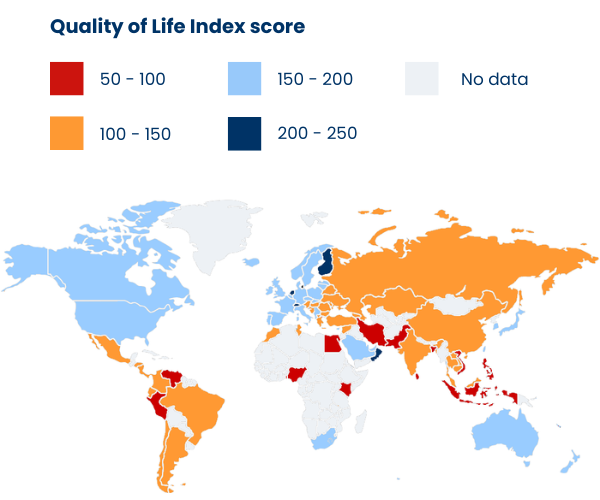
Other countries that make Numbeo’s top 10 include Denmark, Luxembourg, Oman, and Switzerland, each standing out for different reasons, from strong social systems and high incomes.
The graphic below shows the Numbeo Quality of Life score by colour for all countries where data is available across the globe:

Understanding the Quality of Life Index
The table below breaks down the key factors Numbeo uses to calculate its Quality of Life Index.
Each metric captures a different aspect of daily life, helping build a more complete picture of the health, happiness and financial comfort of each country’s residents.
| Factor | What it measures |
|
Purchasing Power Index
|
The amount of goods and services the average salary can buy locally.
|
|
Safety Index
|
Levels of crime and how safe people feel.
|
|
Health Care Index
|
Quality, accessibility, cost, and efficiency of healthcare services.
|
|
Cost of Living Index
|
The relative cost of everyday expenses such as groceries, utilities, transport, and dining out.
|
|
Property Price-to-Income Ratio
|
The relationship between average property prices and average household income.
|
|
Traffic Commute Time Index
|
The average time people spend commuting to work.
|
|
Pollution Index
|
Levels of air, water, and environmental pollution.
|
|
Climate Index
|
How pleasant the climate is based on temperature, humidity, and seasonal comfort.
|

Top 10 countries with the best quality of life in 2026*
The top 10 countries with the best quality of life in 2026 are the Netherlands, Denmark, Luxembourg, Oman, Switzerland, Finland, Austria, Germany, Iceland and Norway, according to Numbeo’s Quality of Life Index.
Below, we dig into the data and find out what makes these destinations such great places to live.
1. The Netherlands
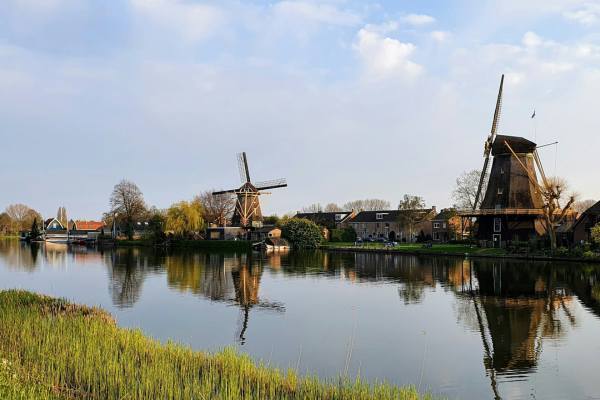
Life in the Netherlands is defined by balance. Decent salaries and strong purchasing power give residents financial stability, while well-planned cities make everyday life easier and more enjoyable. The country is also famous for its cycling culture, with more than 35,000 km of dedicated bike paths, perfect for stress-free commutes!
However, a housing shortage has pushed property prices and rents to some of the highest levels in Europe. And you might want to pack an umbrella, as the weather is often damp and short on sunshine. Despite these drawbacks, the Netherlands’ progressive policies and safe streets still make it one of the most desirable places to live in the world.
Quality of Life score: 213.6
Average annual salary: €48,000 (US$55,386/£41,477)
Healthcare system type: Universal (with mandatory private insurance)
Level of crime: 27.95 (low)
Average annual sunshine: 1,653 hours
2. Denmark
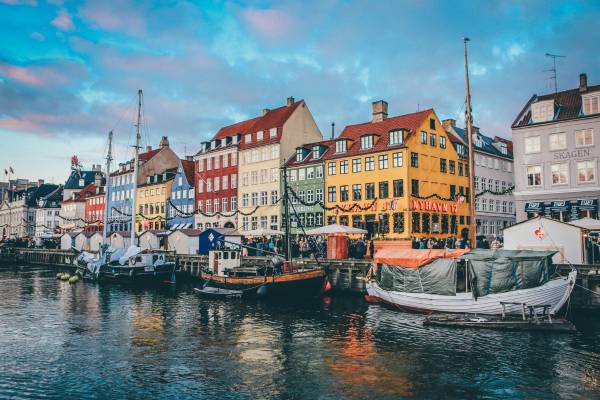
Protected by a strong social safety net and a culture that prioritises wellbeing over long hours at the office, it’s no wonder that the Danes are so content. The country is famous for its generous welfare system, free healthcare and high-quality schools. Plus, it’s common for employees to finish work in the early afternoon, leaving plenty of time for family, hobbies, and the cosy Danish concept of hygge.
On the flip side, day-to-day expenses are high, with groceries, restaurants, and housing often costing a hefty price. Income taxes are also among the world’s highest, although they fund the country’s extensive public services. Even so, Denmark's security, equality, and community spirit easily outweigh the negatives.
Quality of Life score: 212.2
Average annual salary: DKK 395,500 (US$61,144/€52,933)
Healthcare system type: Universal, tax-funded
Level of crime: 24.84 (low)
Average annual sunshine: 1,630 hours
3. Luxembourg
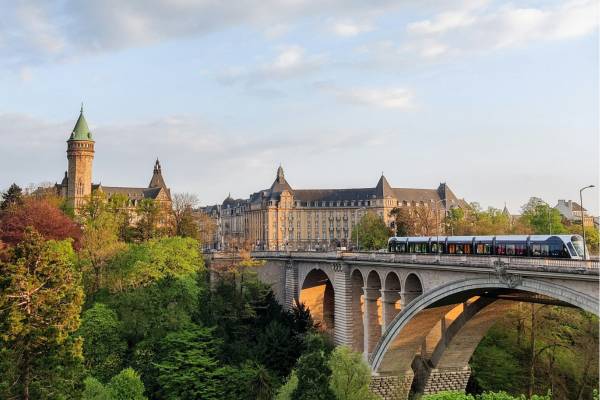
Luxembourg might be 136 times smaller than Germany, but its thriving financial sector means its citizens enjoy some of the biggest salaries in Europe, as well as superb infrastructure and state-of-the-art public services. Their government even introduced free nationwide public transport in 2020, reducing pollution and making commutes a breeze.
Despite its many advantages, Luxembourg’s popularity with international workers has pushed housing prices to extreme levels, and there are fewer entertainment options compared with larger nations. These drawbacks aside, this small but mighty country remains an attractive destination for professionals seeking abundant career opportunities and a safe haven to call home.
Quality of Life score: 211.9
Average annual salary: €75,919 (US$87,433/£65,679)
Healthcare system type: Universal (with mandatory private insurance)
Level of crime: 33.39 (low)
Average annual sunshine: 1,796 hours
4. Oman
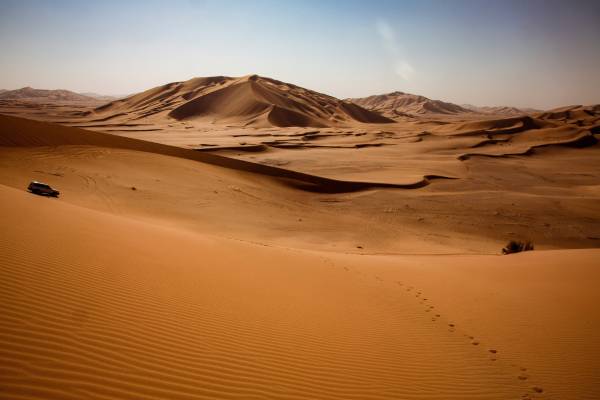
Over the past few decades, Oman has invested heavily in healthcare, infrastructure and education, significantly raising living standards for the country’s population. New residents can now expect to benefit from low crime rates and a cheaper cost of living compared to many Western countries, with cities like Muscat offering a laidback pace, clean surroundings and access to stunning natural landscapes, from expansive desert dunes to dramatic coastlines.
Of course, there are trade-offs to consider. Summer temperatures are scorching, often exceeding 40°C, limiting outdoor activity during the hottest months and salaries in some sectors are slightly lower than in neighbouring Gulf countries. But find yourself a job in the country's flourishing energy sector, and you’re bound to fall in love with Oman’s cultural delights and welcoming atmosphere.
Quality of Life score: 207.6
Average annual salary: OMR21,000 (US$54,620/€47,412)
Healthcare system type: Universal, tax-funded
Level of crime: 11.42 (very low)
Average annual sunshine: 3,500 hours
5. Switzerland
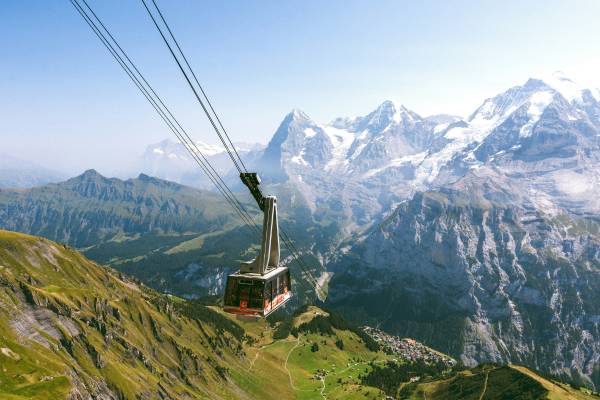
Picture a country where pristine lakes sit beneath snow-capped mountains, and trains run so precisely you could set your watch by them — welcome to Switzerland! The country’s reputation for efficiency and prosperity is well-earned, boasting one of the world’s strongest economies, top-tier healthcare and exceptionally low crime rates.
That said, the Swiss lifestyle doesn’t come cheap. Daily expenses can be eye-wateringly high, particularly in major cities like Zurich and Geneva. Yet many consider it a small price to pay for the chance to live among breathtaking scenery with easy access to outdoor adventures, from snowshoeing to canyoning.
Quality of Life score: 206.2
Average annual salary: CHF84,000 (US$105,389/€91,513)
Healthcare system type: A decentralised, federated model of universal coverage
Level of crime: 24.77 (low)
Average annual sunshine: 1,694 hours
6. Finland
In Finland, quality of life is closely tied to nature, simplicity, and a strong sense of social trust. The country consistently ranks among the happiest nations in the world thanks to its friendly communities, top-quality public services, and spacious cities that effortlessly blend modern architecture with abundant green spaces.
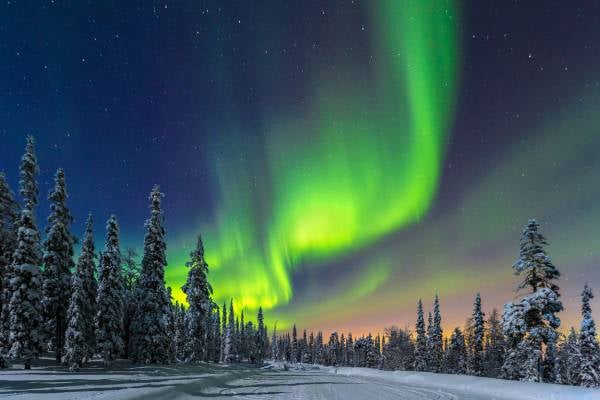
Of course, Finland’s serene lifestyle comes with its own unique challenges. Winters can feel almost otherworldly, with darkness stretching for weeks in the north, testing residents’ resilience. Yet for many Finns, the reward of unparalleled natural beauty on your doorstep, including the chance to gaze up at the aurora borealis approximately 200 nights a year, more than compensates.
Quality of Life score: 204.4
Average annual salary: €53,245 (US$61,316/£46,090)
Healthcare system type: Universal, tax-funded
Level of crime: 24.20 (low)
Average annual sunshine: 1,840 hours
7. Austria
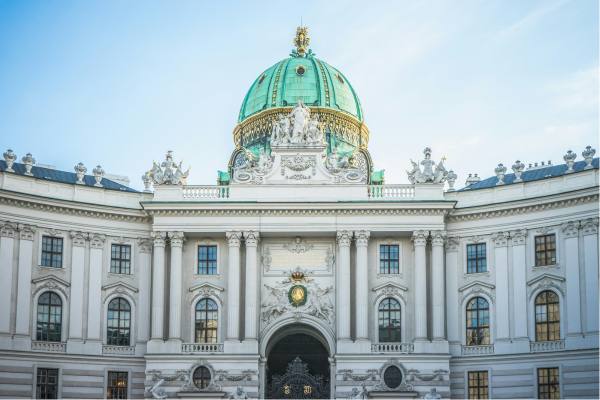
From imperial palaces and world-class concert halls to rolling vineyards and hills that might make you want to sing, Austria is where modern comforts meet old-world charm. Meticulously maintained streets, well-supported communities and a healthcare system ranked among Europe’s best make daily life not just convenient but genuinely pleasurable.
Unfortunately, rental prices in Vienna have surged by over 40% in the past decade, sending city living costs soaring, while heavy snowfall and icy roads can disrupt travel. Even with these challenges, many Austrians feel the country’s mix of vibrant culture and majestic landscapes creates a lifestyle that few countries can match.
Quality of Life score: 199.8
Average annual salary: €51,500 (US$59,279/£44,568)
Healthcare system type: Two-tier healthcare system based on Statutory Social Insurance (SHI)
Level of crime: 27.16 (low)
Average annual sunshine: 1,917 hours

8. Germany
Get ready to spend your working hours earning a competitive salary in one of Germany’s many buzzing tech start-ups and your weekends admiring the country’s 50+ UNESCO World Heritage sites. Although you’ll find it hard to choose a home, are you drawn to the bustling busyness of Berlin, the chocolate-box charm of Munich or the scenic beauty of the Rhine Valley?
However, Deutschland does have its quirks. Rents are steep in major cities, and the nation’s notoriously complex bureaucracy can frustrate residents navigating official processes. Still, most people find these hurdles easy to overcome thanks to the many economic opportunities Germany offers.
Quality of Life score: 196.3
Average annual salary: €51,876 (US$59,687/£44,943)
Healthcare system type: Universal (with mandatory private insurance)
Level of crime: 40.57 (moderate)
Average annual sunshine: 1,718 hours

9. Iceland
Few places on Earth feel as untouched by time as Iceland, where everyday life unfolds among volcanoes, glaciers, waterfalls, and hot springs. With a population of just under 400,000, the country might feel empty and remote, but its communities are close-knit and supportive. The country also runs largely on renewable energy, with around 85% of homes heated by geothermal power.
Life on an isolated North Atlantic island inevitably comes with a few realities that residents must adapt to, including unpredictable weather and high food prices, as most goods must be imported. But many Icelanders wouldn’t change a thing, delighting in the country’s sense of freedom, safety, and closeness to nature.
Quality of Life score: 195.8
Average annual salary: ISK6,000,000 (US$48,150/€41,841)
Healthcare system type: Universal, tax-funded
Level of crime: 20.08 (low)
Average annual sunshine: 1,327 hours
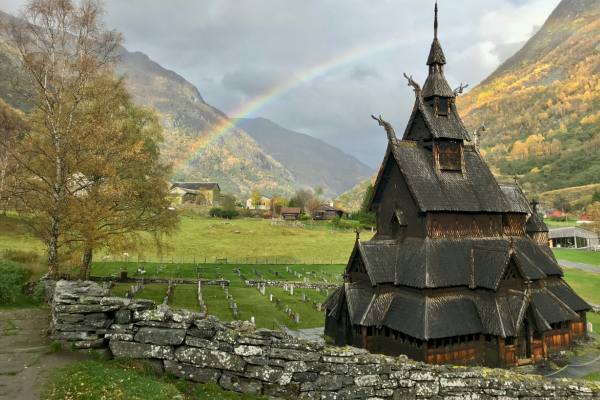
10. Norway
Thanks to oil and gas revenues, Norway has built the largest sovereign wealth fund on the planet, worth over $1 trillion, which helps support public services and future generations. The country also places a strong emphasis on work–life balance, with employees benefiting from generous parental leave and extensive employee protections.
However, Norway does have a few uniquely Nordic challenges. Strict alcohol regulations mean drinks over 4.7% ABV can only be bought from state-run stores called Vinmonopolet, often at high prices and limited hours. But these quirks are only a small part of life in a country that consistently prioritises fairness and long-term wellbeing.
Quality of Life score: 195.4
Average annual salary: NOK637,800 (US$65,724/€57,038)
Healthcare system type: Universal, funded by the National Insurance Scheme (NIS)
Level of crime: 32.66 (low)
Average annual sunshine: 1,676 hours
*figures accurate as of 2026
Sources: numbeo.com, weather-and-climate.com, remotepeople.com
Discover more moving abroad inspiration

Most beautiful country in the world
The most beautiful countries in the world are Greece, New Zealand, Italy, Switzerland, Spain and Thailand. Click to discover the most beautiful cities and states.

Happiest country in the world
The happiest country in the world is Finland, followed by Denmark, Iceland, Sweden, the Netherlands, Costa Rica, Norway, Israel, Luxembourg and Mexico.

Best countries for digital nomads
The best countries for digital nomads are Spain, the Netherlands, Uruguay, Canada, and the Czech Republic, according to the Global Digital Nomad Report.

Seven Seas Worldwide's Movers Report 2025
The most moved to countries are Luxembourg, Switzerland, Denmark, Australia, and Spain, according to the Seven Seas Worldwide 2025 Movers Report.
Sign up to find outmore about our MoveCube®!

Looking for safe and secure international shipping and removals?