Unfortunately, due to the ongoing conflict in the Middle East, shipping lines have temporarily suspended shipments to and from the UAE, Oman, Kuwait, Qatar, Bahrain, and Saudi Arabia until further notice.
We are making user experience upgrades between 06.00 - 12.00 UTC on 07/03/2026. During this time, our website may be disrupted. We apologise for any inconvenience and thank you for your patience.


Moving overseas advice
US states with lowest property tax
Key takeaways
- The state that has the lowest property tax is Hawaii with an average rate of around 0.27%.
- Other states with low property tax rates include Alabama (0.40%), Arizona (0.42%), and Idaho (0.43%).
- There are no US states without a property tax, although some have significantly lower rates than others.
What state has the lowest property tax?*
The state that has the lowest property tax is Hawaii with an average rate of around 0.27%, as it relies primarily on tourism-related taxes to fund public services. However, despite the low tax rate, homeowners often end up paying more because of the state's extortionate house prices.
Other American states with low property tax rates include Alabama (0.40%), Arizona (0.42%), and Idaho (0.43%). While Alabama benefits from cheaper homes and state laws restricting tax increases, Arizona’s lower rates are offset by fast-rising property values, and Idaho has modest home prices outside its major cities.
While these states offer homeowners financial relief through lower tax rates, other factors such as income taxes, sales taxes, and public service funding should be considered when evaluating the overall tax burden.
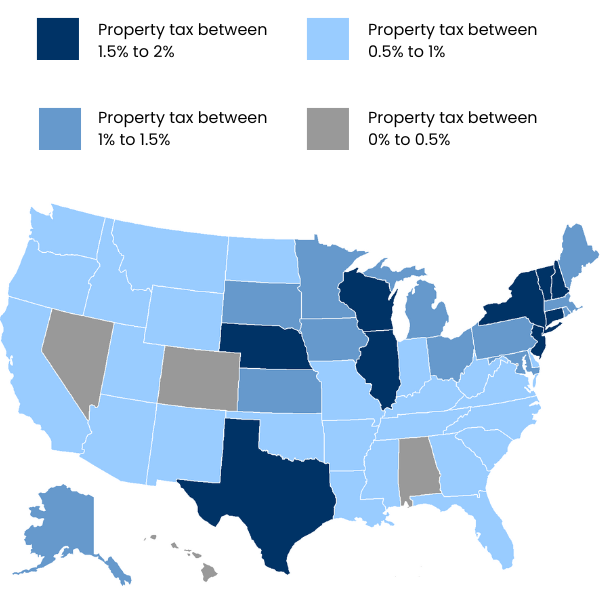
Property taxes by state
The graph below shows the range of property tax rates by state across the US:

10 states with lowest property taxes
To help with your move to the US, the table below shows the 10 states with the lowest property taxes and their median house prices:
| State | Property tax rate | Median home value |
| Hawaii | 0.27% | US$887,100 (£655,775) |
| Alabama | 0.40% | US$266,900 (£197,301) |
| Arizona | 0.42% | US$453,500 (£335,243) |
| Idaho | 0.43% | US$453,400 (£335,169) |
| South Carolina | 0.46% | US$338,200 (£250,009) |
| Tennessee | 0.46% | US$360,700 (£266,642) |
| Nevada | 0.48% | US$465,300 (£343,966) |
| Utah | 0.48% | US$553,400 (£409,092) |
| Delaware | 0.49% | US$377,500 (£279,061) |
| Colorado | 0.56% | US$586,700 ($433,709) |
Source: The Money Fool
*tax rates and home values accurate as of 2026

Property taxes fund essential services like public schools, police and fire departments, and road maintenance.
States with no property tax
There are no US states without a property tax, although some have significantly lower rates than others. Within states, local governments levy annual property taxes on real estate, including land and buildings, based on their value. Some states, such as Connecticut, Virginia, Mississippi and Rhode Island, also tax personal property, including vehicles and business equipment. Many jurisdictions offer exemptions or reductions for certain groups, such as seniors, those with disabilities and veterans.
When buying a home, it's important to budget ahead of time. Property taxes fund essential services like public schools, police and fire departments, and road maintenance. Local governments calculate property rates based on a percentage of the home's market value multiplied by the local tax rate (sometimes called the "millage rate"). For example, if a home is worth US$200,000 (£159,500) and the tax rate is 1.5%, the yearly property tax would be US$3,000 (£2,300).
Learn more about moving to the US

Moving to USA
Moving to America? From choosing a US city to finding a job, booking US removals, to understanding the culture, read this guide for a seamless relocation.

US customs declaration: form 3299
US custom form 3299 is a mandatory document that those returning or moving to the USA must complete to ship belongings tax-free into America. Learn more.

What is a green card?
A green card (or Permanent Resident Card), is an identity document issued by USCIS that allows non-US citizens to live and work in the country. Learn more.

Shipping to the USA
Trusted for over 25 years to ship luggage, boxes and household items from the UK to the USA.
Sign up to find outmore about our MoveCube®!

Looking for safe and secure international shipping and removals?