Unfortunately, due to the ongoing conflict in the Middle East, shipping lines have temporarily suspended shipments to and from the UAE, Oman, Kuwait, Qatar, Bahrain, and Saudi Arabia until further notice.


Moving overseas advice
US states with lowest income tax
Key takeaways
- The states with the lowest income taxes are Alaska, Florida, Nevada, New Hampshire, South Dakota, Tennessee, Texas, Washington and Wyoming.
- Texas does not have a state income tax, making it a financial haven for many expats and businesses.
- "State tax burden" refers to a state's overall financial impact on the total taxes an individual owes — it includes income tax, property tax, and sales and excise tax.
...federal income taxes, charged progressively from 10 to 37% depending on income, apply to all.
States with lowest income tax
The states with the lowest income taxes are Alaska, Florida, Nevada, New Hampshire, South Dakota, Tennessee, Texas, Washington and Wyoming.
Each state charges zero income taxes for residents. However, when moving to the US, it's important to know that federal income taxes, charged progressively from 10 to 37% as of 2026 depending on income, apply to all. Many states fund public services through other means, such as higher sales or property taxes, tourism (Florida and Nevada) and the sale of natural resources (Alaska and Wyoming).
While free from state-level income taxes, Washington charges a 7% capital gains tax when selling assets such as stocks, bonds and business interests over US$250,000 (£199,423) annually. New Hampshire, which also levies zero state income taxes, charges 3% on all interest and dividend gains as of 2026.

Does Texas have state income tax?
Texas does not have a state income tax, making it a financial haven for many expats and businesses. This tax-friendly policy attracts entrepreneurs, remote workers and retirees looking to maximise their income. The Lone Star State generates revenue to fund public services like schools, roads, and emergency services through other means, such as combined state and local sales tax (one of the country's highest at 8.2% as of 2026), property taxes and business franchise levies.
Without state income tax, residents have more disposable income for local goods and services, such as entertainment, retail and dining. This, in turn, supports the Texan economy by increasing demand, encouraging growth and creating jobs. Thanks to zero business state taxes, Texas is an increasingly favoured location for new companies looking to minimise operational costs. The state's business-friendly environment, tax incentives, and low regulatory burdens make it a hotspot for tech startups, manufacturing, and energy companies.

Top 5 states ranked by highest overall tax burden*:
| State | Total tax burden | Income tax | Property tax | Sales and excise tax |
| New York | 1st | 1st | 4th | 9th |
| New Jersey | 2nd | 3rd | 9th | 17th |
| District of Columbia | 3rd | 5th | 4th | 8th |
| California | 4th | 2nd | 24th | 5th |
| Connecticut | 5th | 5th | 2nd | 32nd |
Top 5 states ranked by lowest overall tax burden*:
| State | Total tax burden | Income tax | Property tax | Sales and excise tax |
| Wyoming | 1st | 1st (0%) | 37th | 6th |
| South Dakota | 2nd | 1st (0%) | 8th | 31st |
| New Hampshire | 3rd | 1st (0%) | 44th | 1st |
| Alaska | 4th | 1st (0%) | 31st | 5th |
| Florida | 5th | 1st (0%) | 20th | 16th |
Tax burden by state*
Deciding which US state has the least impact on your income is not as simple as moving to a state with the lowest income tax. Instead, a better indicator is each state's overall financial impact, including the total taxes individuals owe — known as "state tax burden".
You can calculate state tax burden by combining the following rates:
- Income tax: progressive or flat tax rates, including deductions and exemptions.
- Property tax: based on your home's value, individual city/town tax rates, and potential relief programs.
- Sales and excise tax: state vs. local rates, there may be exemptions on essentials, such as groceries and medicine.
States like Texas tempt new residents with zero state income tax, but they make up for it with higher sales and property taxes. According to Wallethub, despite having a state income tax of 3.69%, Delaware's overall tax burden (6.52%) is lower than Texas (7.77%).
Alongside the highest cost of living in the US, New York tops the tax burden list. Arguably, the state's high quality of living, including outstanding educational institutions and plentiful cultural offerings, is sufficient compensation. Topping the lowest overall tax table sits Wyoming. However, the Equality State's sparse population, long distances between towns, and fewer job opportunities than more populous states make it a less popular relocation destination. Evaluating the entire picture before deciding where to move to in the United States is essential.
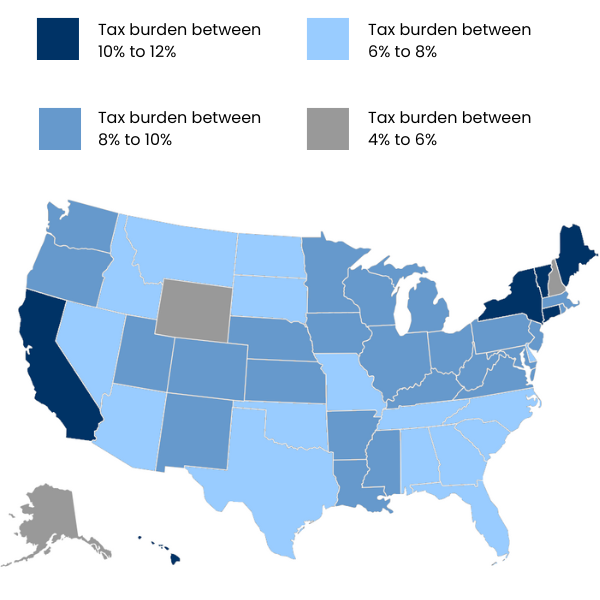
*tax rates accurate as of 2026
Learn more about moving to the US

Moving to USA
Moving to America? From choosing a US city to finding a job, booking US removals, to understanding the culture, read this guide for a seamless relocation.

US customs declaration: form 3299
US custom form 3299 is a mandatory document that those returning or moving to the USA must complete to ship belongings tax-free into America. Learn more.

What is a green card?
A green card (or Permanent Resident Card), is an identity document issued by USCIS that allows non-US citizens to live and work in the country. Learn more.

Shipping to the USA
Trusted for over 25 years to ship luggage, boxes and household items from the UK to the USA.
Sign up to find outmore about our MoveCube®!

Looking for safe and secure international shipping and removals?